
Sex Offender Checks in Lincoln County
The North Carolina Sex Offender and Public Protection Registry is the primary public search. The North Carolina State Bureau of Investigation maintains it from information entered by all 100 county sheriffs. Lincoln County residents can search near an address, by a registrant’s name, with latitude and longitude, or by Sex Registration Number. The state site, rather than a separate county map, is the verified public lookup channel.
The Lincoln County Sheriff registers local residents who fall under Article 27A and handles reports of suspected noncompliance or inaccurate county data. The NCSBI registry overview explains the state and county roles. The registry can change as people report moves, verification status changes, or sheriffs submit updates. Search results should be checked against the full official profile and the date-sensitive nature of the data.
A registry absence is not a full safety clearance. The official registry history and scope does not turn the database into a list of every sexual offense. Not every person convicted of a sexual offense is legally required to register, and the public search excludes confidential juvenile registration data. A name match also needs careful identity review.
Lincoln County Registry Acceptance Rules
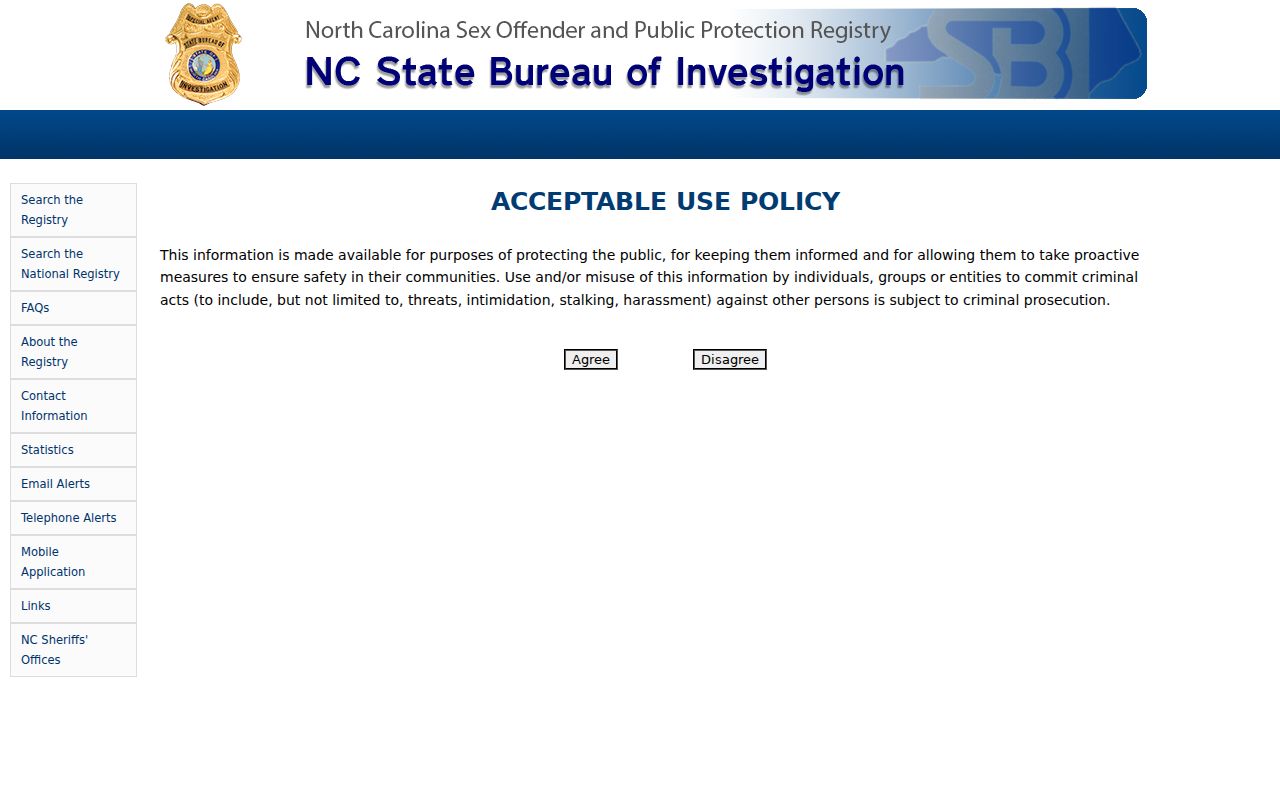
Before a search, the state registry presents an acceptable-use notice. It explains that the data is provided for protection and awareness and warns against threats, intimidation, stalking, harassment, or other criminal misuse. Acceptance is required before moving to search controls. This gate is part of the official service, not a mere pop-up to skip without reading.
The official registry disclaimer and registry FAQ also frame the limits of the information. Some details depend on what registrants report and what a sheriff verifies, so an old address or a possible compliance problem should be reported through the proper official channel. Do not confront a listed person.
Note: Registry data supports informed safety choices, but it does not replace emergency services, a sheriff’s investigation, or fingerprint-based identity confirmation.
How to Search the North Carolina Registry
Choose the search mode that matches what is known. An address-radius search is useful for a Lincoln County location, while a name search fits a known person. Coordinates can refine a map point, and an SRN search fits a known registration identifier. Read the result profile rather than relying only on a marker or list row.
- Open the official NCSBI registry and read and accept its conditions of use.
- Select address, name, latitude and longitude, or Sex Registration Number as the search path.
- Enter the available Lincoln County place or identity details and set a radius when the address mode offers one.
- Open the profile, compare aliases, photograph, physical details, address, status, and reported offense, then note any mismatch for the Sheriff.
| Mode or field | Type | Required | Use and format |
|---|---|---|---|
| Nearby an address | Mode | Choose a mode | Street, city, North Carolina, ZIP, and radius; guidance documents 1, 3, and 5 miles. |
| Name search | Mode | Choose a mode | First and last name, with city or ZIP to narrow the result. |
| Latitude/longitude | Mode | Choose a mode | Coordinates and radius for a defined map point. |
| Sex Registration Number | Mode | Choose a mode | Uses the registry’s SRN identifier. |
| Email Alerts | Linked service | No | Signup for individual or proximity alerts. |
| National Search | Linked service | No | Routes cross-state searching to NSOPW. |
Open the official NCSBI search, accept its lawful-use notice, and then choose the mode that matches the available information.
The official interface carries Lincoln County filters and address searches within the statewide service, so no separate county registry database is needed.
Four Lincoln County Registry Paths
Each search path answers a different question. A name search follows a known identity but can return similar names. An address search asks who is registered within a chosen distance of a location. Coordinates can remove uncertainty about a map point. The SRN route is the narrowest when the unique registration number is already known.
- Name
- Best for reviewing a known registrant, but a name alone is not fingerprint identification.
- Address radius
- Supports awareness around a Lincoln County place, with results dependent on address and map accuracy.
- Coordinates
- Searches around a precise geographic point when the latitude and longitude are entered accurately.
- SRN
- Opens a record tied to a known registration identifier when that number is already available.
Mobile guidance documents one-, three-, and five-mile address choices. Current app-store availability was not verified, so use the responsive official site instead of relying on an old mobile listing. The registry also links its FAQ, statistics, alert signup, contact information, and national search.
Inside a Lincoln County Registry Profile
A public profile combines identity, location, status, and reportable-offense details. Fields can help distinguish people with similar names, yet only a fingerprint comparison can establish identity with that level of certainty. Public display can vary by record, and some collected data may not appear to every user.
| Name and aliases | Lists the registered name and reported alternate names used for identity review. |
|---|---|
| SRN | Provides the Sex Registration Number associated with the registry record. |
| Photograph and description | Can include the latest image and basic physical descriptors. |
| Residence address | Shows the address currently carried in the public registration entry. |
| Reportable offense | Identifies the qualifying conviction description and date. |
| Registration status | Reflects the reported compliance or registration state at publication time. |
| Additional identifiers | Collection can include online identifiers, vehicles, school or work information, and distinguishing marks, but public display must be checked. |
Victim identity is not public. Qualifying juvenile data under Part 4 is also nonpublic and restricted to law enforcement and certain authorized boards or agencies. Those omissions are legal privacy protections, not missing search controls.
Lincoln County Sheriff Registration Office
Registration duties are handled through the Lincoln County Sheriff at 700 John Howell Memorial Drive, Lincolnton, NC 28092. The official county directory gives the main number as 704-732-9050. The exact registration counter, its hours, and whether an appointment is required were not separately published, so call before visiting rather than assuming the general office schedule governs registration tasks.
Lincoln County Sheriff’s Office
700 John Howell Memorial Drive
Lincolnton, NC 28092
704-732-9050
Call first for the registration counter and appointment rule.
Report suspected noncompliance or incorrect Lincoln County data with specific facts. Give the Sheriff enough information to identify the entry and issue without confronting the person shown. Emergencies go to 911. The Sheriff can investigate compliance; the public search cannot determine why a record has not yet changed. The Lincoln County government site remains the official local directory fallback.
North Carolina Registration Levels and Requirements
North Carolina does not use a simple public Tier I, II, and III chart with fixed 10-, 25-, and lifetime terms. Chapter 14, Article 27A instead establishes Part 2, Part 3, and qualifying juvenile programs. Their verification cycles, duration, and public treatment differ.
| North Carolina program | Verification | Duration and public treatment |
|---|---|---|
| Part 2 ordinary reportable offender | Semiannual, at the anniversary and six months; return in person within three business days | At least 30 years from initial county registration; may petition Superior Court after 10 years if statutory criteria are met |
| Part 3 recidivist, aggravated offense, or sexually violent predator | Every 90 days | Lifetime registration; generally not ended through the ordinary Part 2 petition |
| Part 4 qualifying juvenile registration | As the statute and court direct | Nonpublic; restricted to law enforcement and specified agencies or boards |
G.S. 14-208.7 governs initial and change duties, while G.S. 14-208.9A addresses semiannual verification. G.S. 14-208.12A sets the Part 2 termination petition, and G.S. 14-208.23 and 14-208.24 cover the lifetime and 90-day program. G.S. 14-208.29 protects qualifying juvenile information.
Lincoln County Registry Location Rules
For covered registrants, G.S. 14-208.16 imposes a 1,000-foot residence restriction tied to specified places, with statutory exceptions. G.S. 14-208.18 separately limits presence in certain locations for covered offenders. These are legal duties based on the person’s status and the kind of place, not a promise that a simple map radius proves compliance.
A one-mile search circle and a statutory 1,000-foot measurement are not the same tool. Registry mapping supports awareness, while legal distance and exceptions depend on the statute and facts. Direct a suspected violation to the Lincoln County Sheriff. Do not use a map pin as grounds for confrontation or public accusation.
Map limit: An address-radius result shows reported registry geography; it does not decide statutory distance, an exception, or a person’s compliance.
Lincoln County Alerts and National Search
NCSBI offers email alert signup for proximity or individual notices. Alerts can help residents track published changes without repeating the same manual Lincoln County search. They remain tied to registry submissions and should be read with the same accuracy and timing cautions as the public profiles.
When an address, former address, or family connection crosses North Carolina’s border, use the U.S. Department of Justice National Sex Offender Public Website. NSOPW searches participating jurisdictions and adds a cross-state layer that the North Carolina-only registry cannot supply. NC SAVAN or VINELink can serve a different need by providing confidential notifications about covered custody, supervision, or registry status events.
These services are complementary. NCSBI is the official North Carolina record, NSOPW broadens geographic scope, and the Sheriff handles Lincoln County registration facts and compliance reports.
Lincoln County Registry Counts Change
The official statistics interface showed 154 Lincoln County entries when the research was inspected on August 1, 2026. NCSBI labels its county totals approximate, notes that delays and errors can occur, and excludes pending statuses. The number is therefore a dated snapshot, not a permanent measure or a count of every person who has committed a sexual offense.
A change in the total may reflect moves, new registrations, updated status, corrections, or timing in sheriff submissions. Use the official registry statistics interface for a current aggregate count and the main search for individual public profiles. Neither tool should be converted into an unsupported claim about risk in a street, town, or neighborhood.
Community Notification and Lawful Use
The registry exists for public protection and awareness. Lawful use includes learning about registered locations, signing up for official alerts, checking information relevant to family or community safety, and reporting a concrete accuracy or compliance concern. Responsible use accounts for the fact that information changes and that a profile is not a full criminal-history file.
A registry listing should not prompt threats, surveillance, confrontation, or efforts to punish a person outside the justice system. Victims and juvenile registrants receive specific protections, and a household may include people who are not registrants. Report urgent danger to 911 and non-emergency compliance facts to the Lincoln County Sheriff.
Misuse is prohibited: The NCSBI registry warns that threats, intimidation, stalking, harassment, or other criminal misuse may be prosecuted under North Carolina law, alongside the registry duties in Chapter 14, Article 27A.
An apparent name match is not fingerprint identification. Confirm the profile’s aliases, photograph, physical description, SRN, reported address, and qualifying offense before drawing a conclusion, and let the Sheriff investigate disputed data.